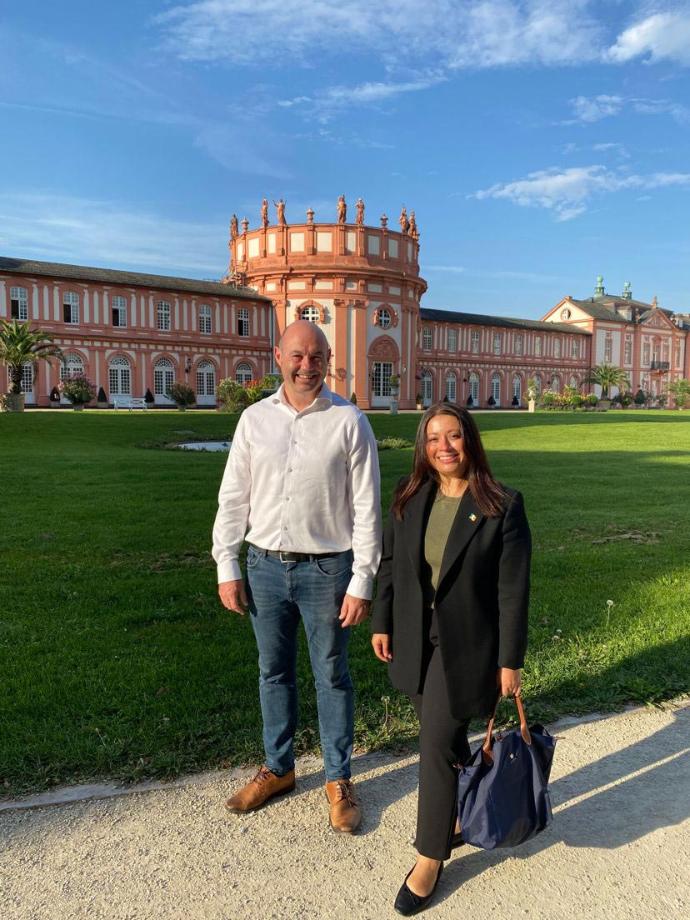
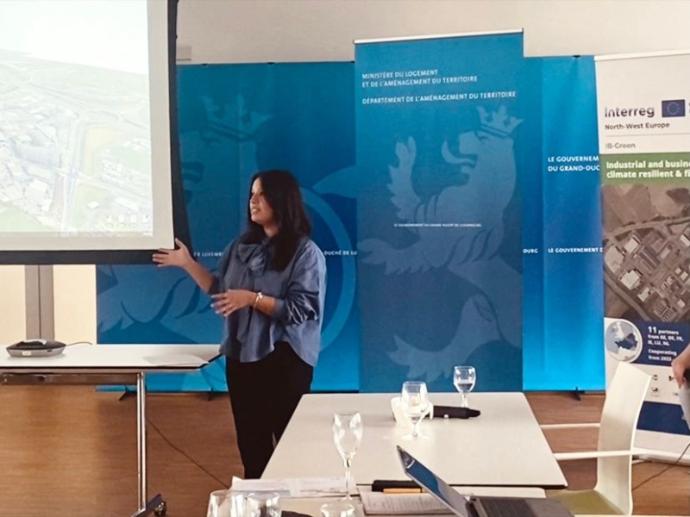
Sandyford Business District is one of two Irish project partners in IB-Green and responsible for implementing pilot measures in Sandyford business park. Together with her colleague Ger Corbett, Fernanda Pinto Godoy is the driving force behind IB-Green at Sandyford Business District.

Pictures © INFRASTRUKTUR & UMWELT, l.t.r: Fernanda Pinto Godoy, Ger Corbett
Why do you think IB-Green is an important project, especially from the perspective of your organisation?
For us, IB-Green is a key opportunity to tackle climate change in a practical and impactful way. SBD is home to over 1,000 companies, 25,000 employees, and 6,000 residents, all within a highly sealed and urbanised environment. That means issues like urban heat island effect (UHI), limited green space, and reduced biodiversity directly affect daily life here.
By joining IB-Green, we can work with European partners to bring more green infrastructure and quality public spaces into the district. It’s a chance to create a better and more enjoyable place for everyone who works and lives in Sandyford while preparing our business park for a climate-resilient future.
What is the most important thing that you have learnt so far during IB-Green? What would you like to learn more about during the duration of the project?
One of the biggest learnings so far has been the value of transnational cooperation. Working closely with our European partners has given us great insight into their challenges, their best practices, and how some of their ideas could be adapted here in Sandyford.
Locally, the project’s risk assessment has been a real highlight. It enabled us to invest in geospatial mapping to better understand the urban heat island effect and tree density cover across the district. Having the right data is essential since it allows us to make informed, strategic decisions that will genuinely improve the area.
Looking ahead, we are keen to keep learning from our partners and to deepen our understanding of green infrastructure solutions that can be scaled and applied within a busy business district like ours.
Which of your own project activities are you most looking forward to and why?
We are most excited about seeing our pilot project come to life, an 0.8 hectare site that we are transforming into a new civic park right in the heart of Sandyford. This space will offer huge value to the 25,000 people who work here and the 6,000 residents who call the district home.
We are working with Urban Agency, the leading landscape architects, who are bringing the park’s design to life. We’ve put a great deal of thought into the design phase to ensure it showcases the best in sustainability, SuDS, and circular-economy principles. Wherever possible, we are reusing materials from on-site demolitions and keeping resources within the project. Watching this space evolve into a green, climate-resilient, community-focused park is something we are really looking forward to.
What other EU or INTERREG financed projects are you working on?
Besides IB-Green Sandyford Business District is currently involved in two further EU-funded initiatives as a project partner:
- CircularPSP (Horizon Europe) – developing a public service platform that uses taxonomies, AI, and NLP to help cities move towards circularity.
- RECUP – Reinventing Culture in Urban Places (URBACT) – aimed at mitigating social fragmentation and digital isolation in urban environments.
In addition, we are an associated partner in CircularShift (INTERREG), which works to accelerate circular procurement practices for items such as phones, laptops, and workwear.
What do you think is most important when convincing people to become active for climate adaptation?
We think that probably the most important thing is to make climate adaptation relevant and tangible for people. When individuals can see how actions directly improve their daily lives, like greener public spaces, or safer communities, they are much more likely to get involved.
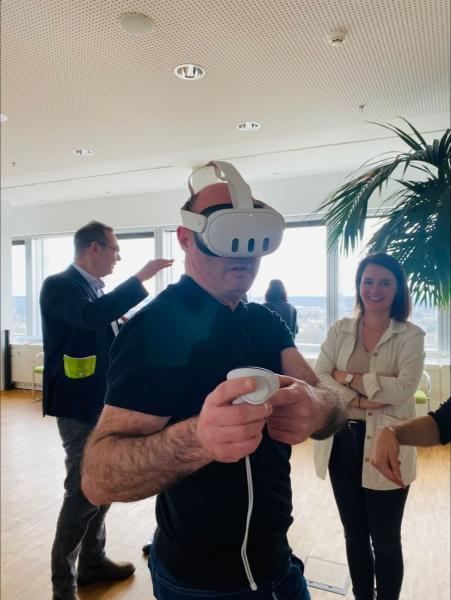
Education and awareness are key, and one of the greatest tools we have in Sandyford is our digital twin: a 3D model of the district enriched with layers such as the urban heat island map and tree density cover. This allows us to present complex information in a clear, engaging way for different audiences.